 Blog

SHARE THIS ARTICLE


Contents:
- Live deployments tell only part of the story
- Banks are investing carefully
- What building readiness involves
- What should the next deployment leave behind?
AI is already at work in Indian banks. It is helping teams serve customers, analyze risk, process loan documents and write software. Banks have good reasons to be confident about its potential.
What is less clear is how prepared they are to use it more widely. Getting an application into production takes considerable work, but even a successful deployment may depend on arrangements built specifically for that project. Other teams cannot necessarily use the same data, integrations or controls.
We developed Crossing the AI Divide, with Banking Frontiers as our knowledge partner, to examine where banks stand. The report draws on a survey of 40 CXOs across 18 Indian banks and NBFCs. We wanted to bring evidence to a discussion that has often relied on sweeping claims about what AI is doing to banking.
The findings show real progress. But they also show that the systems, processes and skills needed for wider adoption still need work.
Live deployments tell only part of the story
Seven in ten CDOs place their institutions at selective or scaled AI deployment. Our assessment of the capabilities supporting those deployments gives a more cautious picture. Data and infrastructure are furthest ahead, while governance, engineering and workforce readiness remain closer to pilot stages.
The difference is understandable. Leaders assessing adoption are looking at applications already running in their banks. We also looked at what would be needed to extend AI into other functions and give it greater responsibility.
Take a lending team using AI to interpret documents. It may have spent months arranging data access, connecting applications, setting permissions and deciding how staff should review the results. When the collections team introduces AI, some of that work may have to start again. The requirements also change if AI is expected to recommend a repayment arrangement or initiate an action, rather than read a document.
Readiness is about how well the bank can support these changes. A project can work well within its own boundaries while the bank still has more to do before extending it.
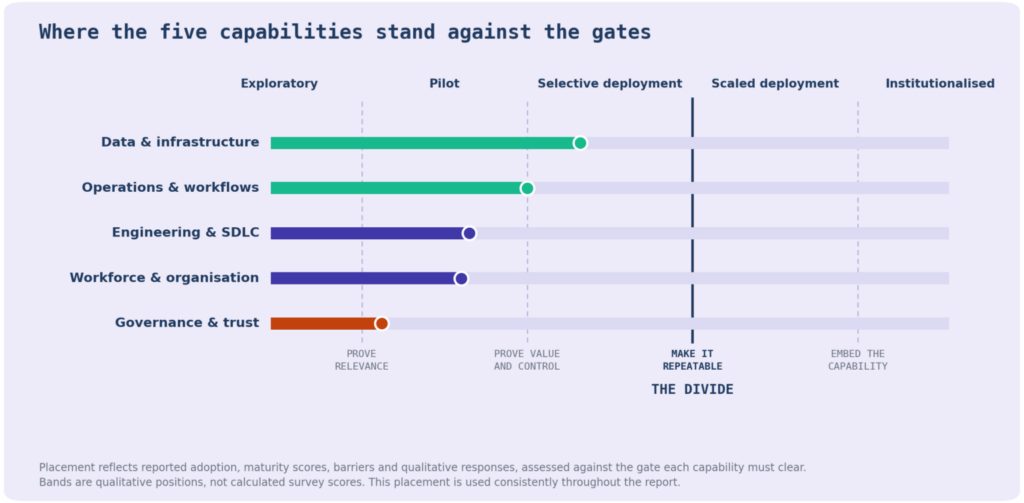
Figure 1. Self-assessed deployment maturity is ahead of underlying capability readiness.
Banks are investing carefully
Most institutions allocate less than 10% of new-project technology spending to AI, 5-6% being the median as per our study. That is a modest share, but it should be read alongside their views on what is holding adoption back.
Lack of ROI clarity ranks among the lowest barriers cited by technology leaders. Security and data privacy are much greater concerns. The willingness to use AI is there; confidence in the arrangements needed to support it more widely is less established.
The study itself cannot explain every budget decision. Still, the findings suggest that banks are taking a measured approach while they work through questions of control, reliability and oversight.
There are good reasons for that caution. The consequences of a poor draft response are different from those of an incorrect lending decision or an unauthorised change to a production system. Banks need to prepare for the responsibilities they intend to give AI.
What building readiness involves
The report examines four areas where further work can help banks get more from AI.
- Banking systems need to give AI more than access: Real-time data platforms and APIs are increasingly in place. AI also needs to understand the information it receives and the rules governing its use. A credit limit, for example, needs account context: what has been used, what is available, whether the account is overdue and what policy allows. Systems must provide that context and enforce the relevant permissions.
- Processes need to make better use of AI’s reasoning: Banks are seeing benefits from individual tasks such as reading documents or drafting responses. AI could contribute more by bringing information together, assessing a case and helping determine the next step. That requires systems and processes that support its involvement, including clear limits on its authority and points where a person must approve the action.
- Governance policies need systems that can enforce them: Governance is the least mature capability assessed in the report. None of the dimensions examined shows sufficient readiness for scaled adoption. Banks need ways to apply permissions, oversee model risk, protect private information and record decisions and actions. Staff should be able to establish what AI did, why it did it and whose approval it received.
- Engineering practices and internal skills need to develop together: AI use has progressed well in testing and code generation. Banks are more cautious about deployment and live systems, where mistakes can affect operations directly. Controlled access, review and traceability will be necessary as AI takes on more responsibility. Teams also need the skills to assess its outputs, recognize when it is wrong and supervise its actions.
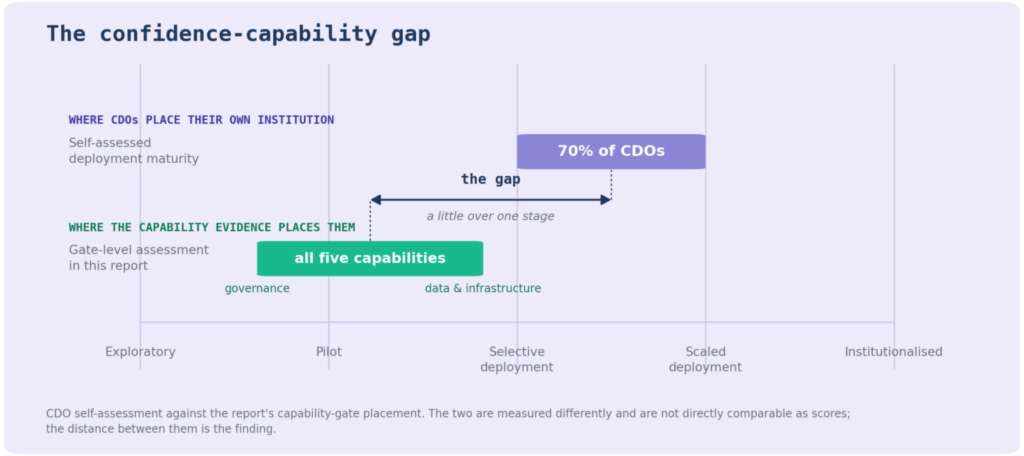
Figure 2. Readiness is developing unevenly across the capabilities needed for broader AI adoption.
What should the next deployment leave behind?
The number of live AI applications is a useful measure of adoption. However, banks should also look at what they gain from each deployment beyond the application itself.
Can AI be introduced into another process without recreating the same foundations? Can it contribute more to a decision while preserving human accountability? Are teams better equipped to evaluate its performance and improve the outcome?
These questions connect readiness to practical results.
Indian banks now have experience of AI in production. The task ahead is to use that experience to prepare systems, processes and people for a larger role for AI. That will help banks get more value from the technology while maintaining the control and accountability their customers expect.
Read the full report: Crossing the AI Divide
RELATED ARTICLES

- AI in Banking
- 4 min
Path to Value with Elena: A Roadmap for Card Issuers
Learn how card issuers can implement Elena AI to automate 50-80% of customer support contacts…

Salil Ravindran
Product Marketing at Zeta

- AI in Banking
- 4 min
How Elena Earns Customer Trust in AI
Discover how Zeta's AI platform Elena builds customer trust through accuracy, security, and personalization while…

Rahul Bagati
Vice President, Marketing and Strategic Partnerships

- AI in Banking
- 6 min
Next-Gen Card Support is Intelligent, Personalized and Conversational
Elena transforms customer support with intelligent, conversational AI that instantly resolves queries, maintains context, and…
Salil Ravindran
Product Marketing at Zeta